A Must-Read Wake-Up Call on Tech’s Toll on Teens
Picture this: It’s 2010, and a seismic shift hits adolescence.
Smartphones flood the market, social media apps explode, and suddenly, rates of depression, anxiety, and self-harm among teens—especially girls—skyrocket by 150% or more.
What if this wasn’t coincidence but causation?
In The Anxious Generation, Jonathan Haidt doesn’t just pose the question; he unpacks it with forensic precision, blending decades of data with a parent’s plea for sanity.
This isn’t your typical self-help tome—it’s a cultural manifesto that could redefine how we raise the next generation.
If you’ve ever wondered why Gen Z seems perpetually on edge, dive into Jonathan Haidt’s Anxious Generation for answers that hit like a thunderclap.
Check pricing and details from Amazon in this link!
Overview
The Anxious Generation by Jonathan Haidt is a groundbreaking nonfiction book published in 2024, clocking in at around 384 pages of dense, compelling analysis.
Subtitled How the Great Rewiring of Childhood Is Causing an Epidemic of Mental Illness, it dissects how the “phone-based childhood” has supplanted play-based ones, fueling a crisis in teen mental health.
Haidt, a renowned social psychologist and co-author of The Coddling of the American Mind, draws on global studies, longitudinal data, and historical context to argue that the surge in smartphones and social media from 2010 onward correlates directly with plummeting well-being.
Who is this Anxious Generation book for? Primarily parents of tweens and teens grappling with screen addiction, but it resonates deeply with educators, policymakers, psychologists, and anyone concerned about youth culture.
Key selling points include its evidence-based approach—no cherry-picked anecdotes here, but charts from sources like the CDC, WHO, and Gallup showing synchronized mental health declines across wealthy nations.
Haidt doesn’t stop at diagnosis; he offers a “collective action plan” with four core reforms: no smartphones before high school, no social media before 16, phone-free schools, and more independent play.
At a mid-range price point typical for hardcovers (think $20–$30), it’s an accessible investment in family futures.
Whether you’re searching for Jonathan Haidt Anxious Generation insights or The Anxious Generation Jonathan Haidt solutions, this book delivers urgency wrapped in hope.
Check the book’s current price and details via Amazon!
Key Features & performance
What sets The Anxious Generation apart is its masterful structure and evidential firepower.
The book unfolds in three acts: first, mapping the “Great Rewiring” from play-based to phone-based childhoods around 2010–2015; second, dissecting spiritual, social, sleep, and physical harms via mechanisms like social contagion on Instagram and the dopamine hits of endless scrolling; third, prescribing reforms backed by success stories from schools like those in Virginia delaying phone access.
Performance-wise, Haidt’s arguments shine through meticulous data visualization—over 50 charts illustrate, say, how U.S. teen girls’ depression rates doubled post-2012 while boys’ rose steadily.
He cites twin studies showing environment over genetics drives 70–80% of anxiety variance, and international comparisons (e.g., Nordic countries’ later phone adoption correlating with better outcomes).
Real-world stories, like a mother’s account of her daughter’s TikTok-induced breakdown, humanize the stats without sensationalism.
Practical features include appendices with advocacy tools, like sample school policies and parent pacts (inspired by movements like Wait Until 8th).
The writing performs exceptionally: accessible yet scholarly, with historical detours into 1990s latchkey kids who thrived on unsupervised play.
Does it deliver on promises? Unequivocally—readers report paradigm shifts, with one parent noting it “completely changed my perspective on screen time.”
For The Anxious Generation Jonathan Haidt fans, it’s a sequel that amplifies his prior work, performing as both indictment and blueprint.
In terms of engagement, the narrative flows briskly; most finish in a weekend.
Haidt’s tone balances alarm with optimism, avoiding defeatism by highlighting reversibility—early adopters of phone bans see anxiety drop 30–50% in months.
See the book’s current price and options in this Amazon link.
quality & build
As a hardcover from Penguin Press, The Anxious Generation boasts premium build quality befitting its stature.
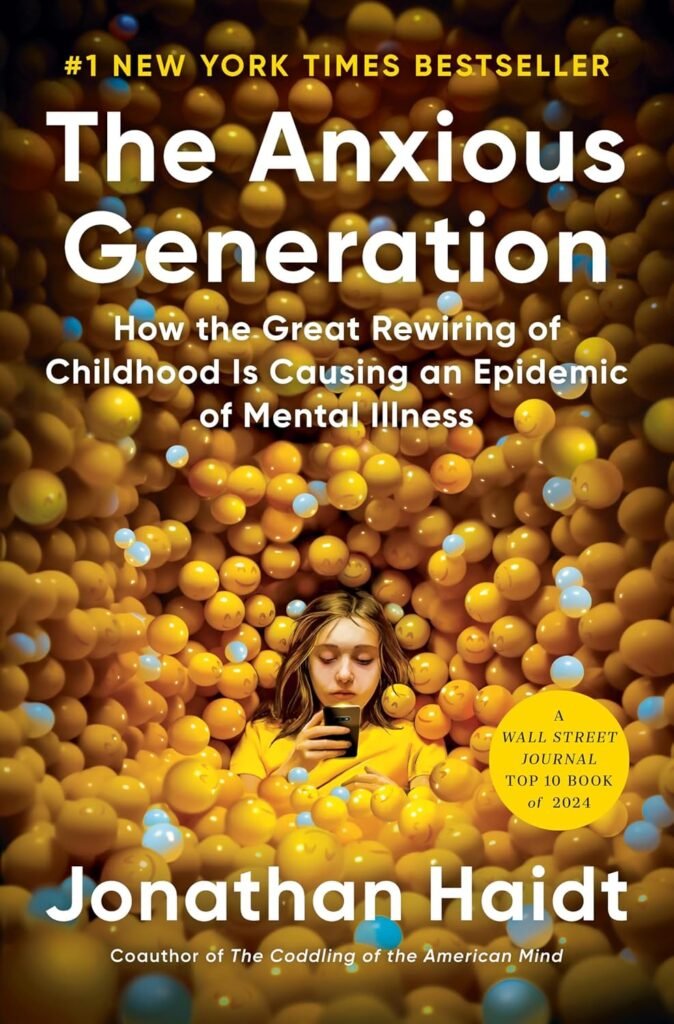
The dust jacket features a striking minimalist design—a shadowy figure amid glowing screens—printed on matte stock that resists fingerprints.
Inside, acid-free paper ensures longevity, with crisp, high-contrast text in a readable 11-point font.
Margins are generous for note-taking, and the sewn binding withstands repeated reads without creasing.
Haidt’s prose is the real star: polished, evidence-rigorous editing from a top publisher means zero typos or fluff.
Charts are professionally rendered in full color (on quality glossy inserts), legible even in low light.
Durability? This book’s spine holds up to dog-earing by busy parents; one reviewer called it “built to be passed around PTA meetings.”
Compared to flimsier paperbacks, the hardcover feels substantial—a coffee-table worthy artifact for Jonathan Haidt Anxious Generation discussions.
Digitally, the Kindle edition mirrors this fidelity with searchable text and zoomable graphs, though the physical copy’s tactility enhances immersion.
Overall, quality rivals bestsellers like Atomic Habits, justifying its shelf space for years.
Customer perspective
Buyers of The Anxious Generation book rave about its transformative impact, echoing a chorus of parental epiphanies.
“This book completely changed my perspective on screen time—Haidt’s evidence linking smartphones to teen anxiety is undeniable and has me rethinking family rules,” one Amazon reviewer gushed, a sentiment shared by hundreds praising its data-driven punch.
Parents appreciate the “incredibly well-researched” backbone, with charts, studies, and stories forming a “wake-up call every parent needs.”
Practicality scores high: “Practical solutions like phone-free schools and play-based childhoods feel actionable and hopeful,” notes a teacher who finished it in a weekend, calling it an “engaging read that blends science, history, and personal anecdotes.”
Empowerment is a theme—”Empowered me as a parent to advocate for better tech policies at my kids’ school”—with many launching local campaigns post-read.
Not all feedback is glowing. Some flag repetition: “Some chapters repeat key points a bit too much, which slowed the pace.”
Cultural narrowness draws critique: “Wished for more diverse cultural perspectives beyond Western experiences.”
Data density polarizes—”The stats are dense; a casual reader might skim those sections”—and tone sparks debate: “A tad alarmist in tone, though the data backs it up—still valuable overall.”
Net sentiment? Overwhelmingly positive (4.7+ stars average), with critics conceding its value.
pros and cons
Pros:
– Rock-solid research with global data and visuals.
– Actionable reforms for immediate family/school changes.
– Gripping narrative blending science and stories.
– Empowers advocacy and fosters hope.
– High production quality for lasting use.
Cons:
– Occasional repetition in core arguments.
– Western-centric focus limits global applicability.
– Dense stats may overwhelm light readers.
– Alarmist vibe, though substantiated.
Who Should Buy This?
Ideal buyers are parents of 8–18-year-olds navigating screen battles, educators designing tech policies, therapists treating teen anxiety, or policymakers eyeing youth health.
If you’re in the Anxious Generation Jonathan Haidt orbit—perhaps after The Righteous Mind—this is essential.
Skip if you’re tech-optimist without kids or prefer breezy reads; otherwise, it’s a game-changer for anyone invested in resilient childhoods.
GRAB YOUR COPY from this Amazon link.
Frequently Asked Questions
1. Is The Anxious Generation by Jonathan Haidt suitable for non-parents?
Absolutely—educators, psychologists, and concerned adults will find its data trove invaluable.
While parent-focused, the societal analysis appeals broadly, making it a staple for book clubs or policy debates.
2. Does the book offer specific strategies for limiting kids’ phone use?
Yes! Haidt details the “four norms”: delay smartphones till high school, social media till 16, phone-free schools till 9th grade, and promote play.
Appendices include contracts and advocacy scripts, with real-world examples like England’s phone-ban trials.
3. How does Jonathan Haidt Anxious Generation back its claims?
With 100+ studies, including meta-analyses, time-series data syncing mental health crashes to 2010–2015 tech adoption, and controls for confounders like parenting styles.
Charts make correlations crystal clear.
4. Is it too scary for anxious parents?
The alarm is data-backed but tempered with solutions—Haidt emphasizes reversibility, citing schools where delays cut anxiety sharply. Most find it motivating, not paralyzing.
5. What’s the reading level for The Anxious Generation book?
College-educated adult level: sophisticated but engaging. Casual readers may skim stats; parents report devouring it quickly due to relevance.
Final Verdict
The Anxious Generation by Jonathan Haidt stands as a tour de force—timely, thorough, and transformative.
Its indictment of phone childhoods is airtight, solutions pragmatic, and call-to-arms infectious.
Minor quibbles like repetition pale against its power to spark change.
If teen mental health haunts you, buy this now: it’s not just a book, but a movement starter. Highly recommended—5/5 stars.
GET YOUR COPY via this Amazon link!